
AI Agent Standards - What Do We Need to Know?
Understanding AI Agent Standards: The Essentials

The search industry is rapidly producing new standards, protocols and frameworks.
Terms like MCP, A2A, ARD or LLMs.txt have been littering LinkedIn and industry publications.
As overwhelming as another collection of acronyms may seem, most of these standards are attempting to solve different problems at different layers of the emerging agent ecosystem.
Mapping these Protocols
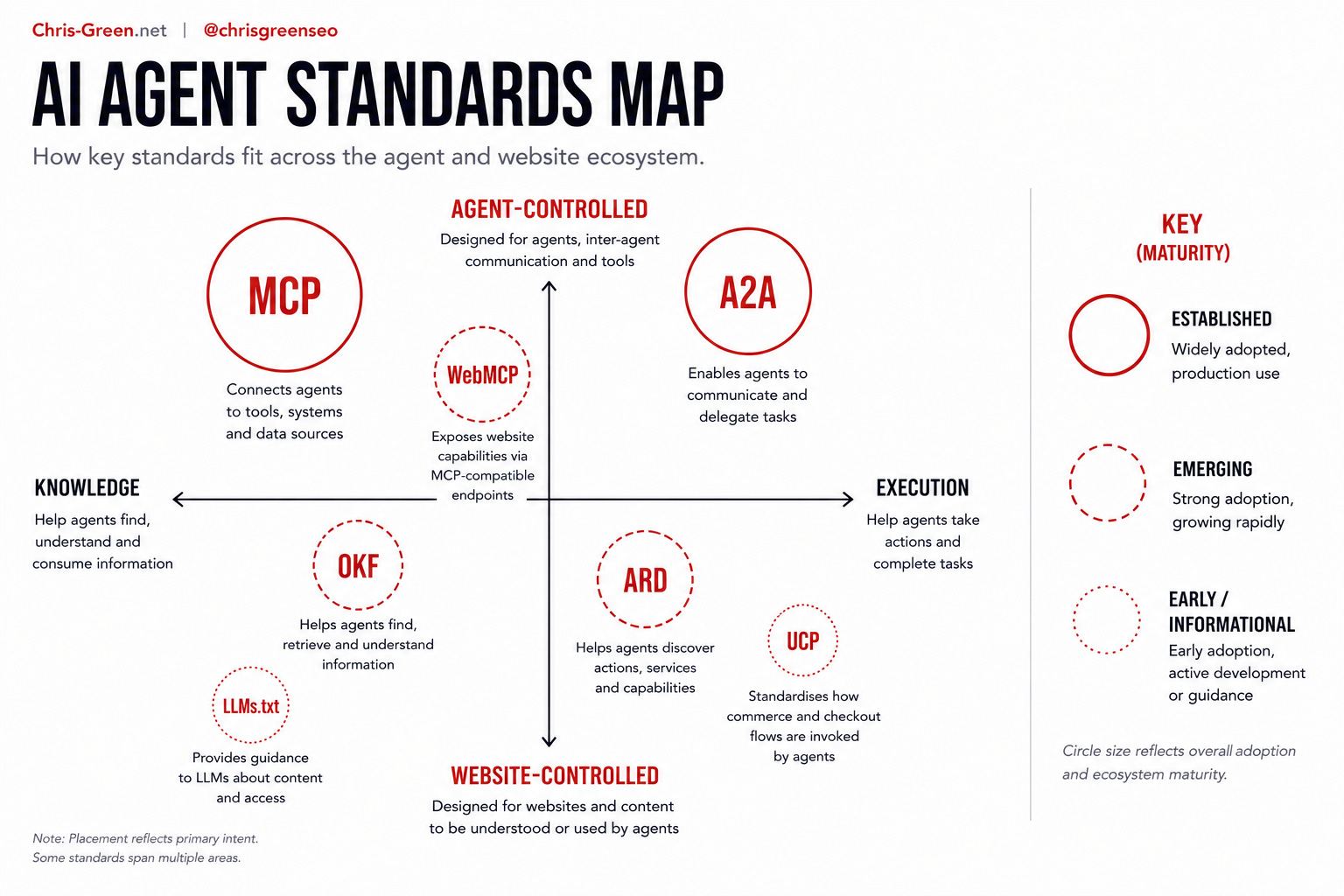
These standards impact different parts of the agent journey and impact in different ways. The map (below) looks at whether the protocol is action oriented (provides agency - agent driven) or knowledge oriented (provides information - considered publisher driven).
This isn’t just a single axis, it helps to think it plotted as:
Action - knowledge
Agent - publisher
These different standards are at different levels of maturity and adoption and mean different things depending on your job and where you spend your time on a day-to-day basis.
The Five-Minute Version
Each of these frameworks can be complex and are changing all the time, so treat the below as a short primer to see if/when/how you should handle each.
For most organisations today, the priority order is:
Understand the landscape
Improve discoverability
Expose capabilities where appropriate
Monitor emerging standards
Many businesses are already worrying about step four while still struggling with steps one and two.
Official Specifications
If you think any of these protocols are what you are looking for, I’d strongly suggest reading their docs as my (quicky) summary above (and the changing nature of this space), means it’s a surer way to get what you need.
Open Knowledge Framework (OKF) - https://cloud.google.com/blog/products/data-analytics/how-the-open-knowledge-format-can-improve-data-sharing
LLMs.txt - https://llmstxt.org/
Agent Resource Discovery (ARD) - https://agenticresourcediscovery.org/
Model Context Protocol (MCP) - https://modelcontextprotocol.io/docs/getting-started/intro
Agent2Agent (A2A) - https://a2a-protocol.org/latest/
Universal Commerce Protocol (UCP) - https://developers.google.com/merchant/ucp
Wait, Don’t Some of These Compete?
Some of these standards overlap, while others solve adjacent problems. In some cases, their creators position them as alternatives for particular use cases, making it easy to assume they’re direct competitors when they’re often complementary.
A2A, for example claims to be a better option than MCP servers in some situations and ARD/WebMCP both appear to more to the same goal.
This table should help understand why/when some standards may be used over others.
The overlap is mostly around discovery, invocation and orchestration.
ARD helps agents find capabilities.
MCP and WebMCP help expose or invoke tools.
A2A helps agents coordinate.
UCP applies these ideas to commerce journeys such as product discovery, cart building and checkout.
What Should We Actually Focus On?
AI agents won’t interact with websites through a single protocol any more than browsers interact with websites through a single HTML tag. The future is likely to involve a collection of complementary (sometimes conflicting) standards, each solving a different part of the interaction between content, capabilities, systems and transactions.
The important thing isn’t to adopt every new acronym that appears. It’s to recognise the problem each one is trying to solve, understand whether it’s relevant to your organisation, and keep an eye on the standards that are gaining genuine adoption rather than simply generating discussion.
After reading this, if you’re thinking you might wait it out a little longer to let the dust settle, you’d be forgiven!
That said, there are a few areas I’d be keeping a close eye on:
If you’re in e-commerce, take a look at UCP. Agentic shopping and checkout are moving quickly, and this is likely to be one of the first standards many retailers encounter.
If you expect AI agents to complete actions on behalf of your customers, keep an eye on WebMCP and ARD. Together, they represent one of the clearest directions of travel for exposing website capabilities to agents.
If you’re concerned about AI systems discovering and understanding large or complex websites, OKF is the standard I’d be watching most closely.
Standards don’t become standards because they’re technically superior. They become standards because enough of the ecosystem adopts them.
Some of the protocols discussed here may become foundational to the future web, while others may merge, evolve or quietly disappear. Understanding what they are today is far more valuable than betting on which one will ultimately “win.”